

Selecting the right steel for house construction is one of the most consequential material decisions on any residential project. Get it wrong, and you risk structural failures, cost overruns at later stages, and a building that does not meet statutory safety standards. Get it right, and your structure delivers decades of reliable performance.
This guide covers everything you need to know: steel grades, TMT bar specifications, IS code requirements, quality checks, and the questions you should ask before procurement begins.
1. What Is Steel for House Construction?
Steel for house construction refers to the reinforcement steel embedded within concrete structural members columns, beams, slabs, footings, and shear walls to carry tensile loads that concrete alone cannot resist.
In India, Thermo-Mechanically Treated (TMT) steel bars are the standard reinforcement material for residential and commercial concrete structures. They combine high yield strengthwith ductility, making them suitable for earthquake-prone zones and structures designed under IS 456:2000.
The type, grade, and quality of steel you choose directly determines the load-bearing capacity, seismic resilience, and long-term durability of your building.
2. Why Steel Grade Matters More Than Price
Most homeowners and first-time developers approach steel procurement by comparing price per kilogram. This is the wrong starting point.
A price difference of ₹ 2–3 per kg between a reputable TMT brand and an unbranded bar may seem negligible on a small project. Over a 2,000 sq ft house requiring 8–12 MT of steel, the cost difference rarely exceeds ₹ 30,000–50,000. But the structural risk differential is significant.
Substandard steel leads to inadequate bond strength with concrete, reduced ductility under seismic loading, and premature corrosion within the cover zone. These are not visible at the time of construction. They manifest years later, often requiring costly retrofitting or, in the worst cases, structural failure.
Across residential and industrial projects, the Noah Construction Excellence System treats material specification as an engineering decision, not a procurement decision. Grade selection precedes vendor selection.
3. TMT Bars: The Standard for Residential Construction
TMT bars are produced through a quenching and self-tempering process that creates a hard outer martensitic layer and a ductile inner ferritic-pearlitic core. This combination gives TMT steel both high yield strength and good elongation two properties that structural concrete demands.
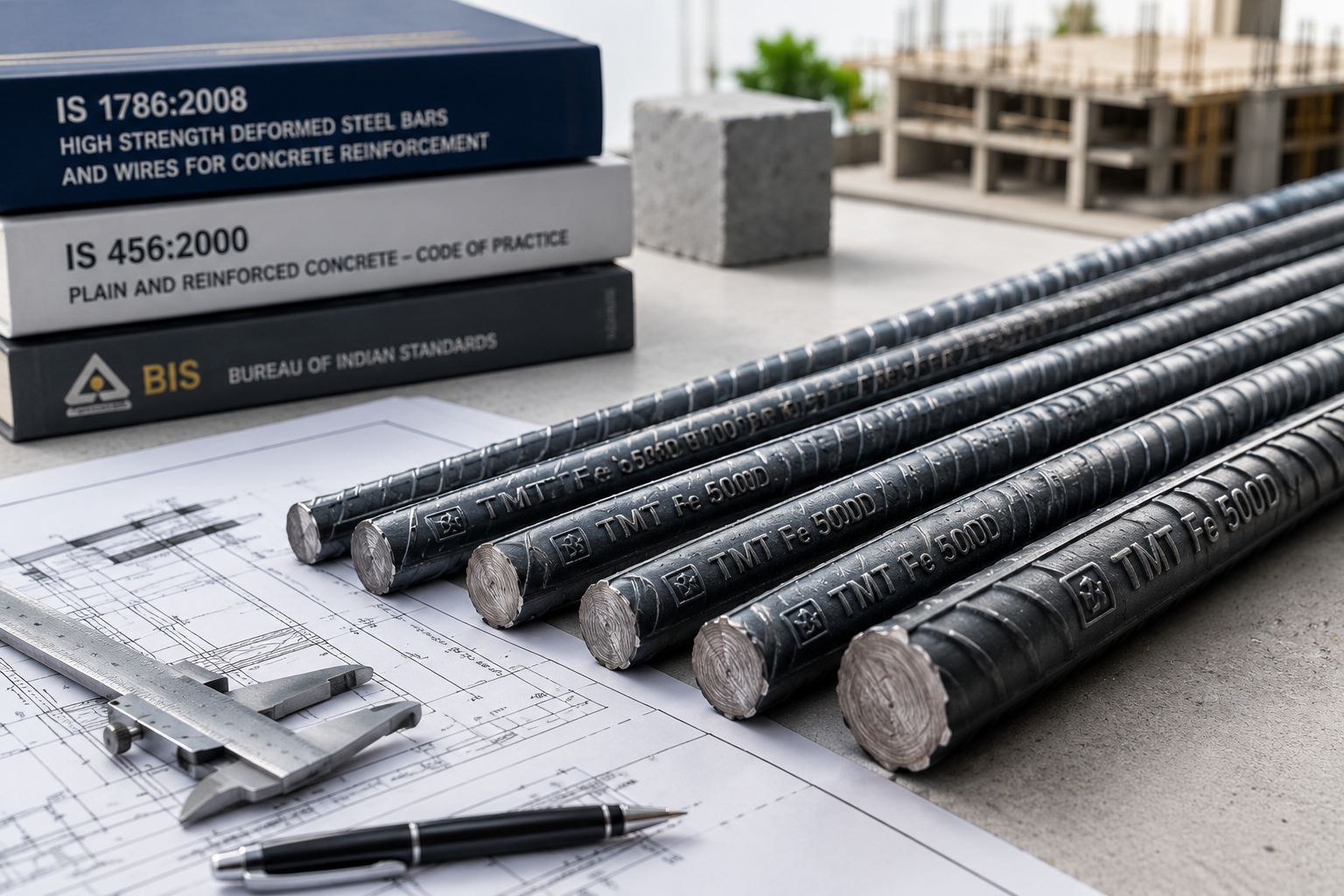
TMT bars comply with IS 1786:2008 (BIS Standard for High Strength Deformed Steel Bars and Wires for Concrete Reinforcement). This is the governing standard for all reinforcement steel used in Indian construction.
Key properties of TMT bars that matter for house construction:
- Yield Strength (0.2% proof stress): The stress at which steel begins to deform permanently. Higher grade = higher yield strength.
- Ultimate Tensile Strength (UTS): The maximum stress the bar can carry before rupture.
- Elongation: The percentage stretch before failure — a measure of ductility. Critical for earthquake-resistant structures.
- Bend and Rebend Test Performance: Bars must pass IS 1786:2008 bend/rebend tests without cracking.
- Chemical Composition (Carbon Equivalent): Controls weldability and corrosion resistance.
4. Understanding TMT Steel Grades
IS 1786:2008 defines the following TMT grades for construction use:
Fe-415
Yield Strength: 415 N/mm² minimum
Use Case: Older designs, minor RCC elements, areas with lower structural demand.
Fe-415 was the dominant grade in Indian residential construction through the 1990s and early 2000s. It remains code-compliant but has largely been superseded by Fe-500 in current projects.
Fe-500
Yield Strength: 500 N/mm² minimum
Use Case: Standard residential construction columns, beams, slabs, footings.
Fe-500 is the most widely specified grade for house construction in India today. It offers 20% higher yield strength than Fe-415, allowing structural engineers to either reduce steel quantity for the same load or increase load capacity for the same quantity.
Fe-500D
Yield Strength: 500 N/mm² minimum
Additional Property: Higher ductility (minimum elongation of 16% vs. 12% for standard Fe-500), lower carbon equivalent.
Fe-500D is recommended for construction in earthquake zones III, IV, and V as defined in IS 1893. The “D” designation stands for ductility. If your project site falls within a seismic zone, this is the grade your structural engineer should be specifying.
Fe-550 and Fe-550D
Yield Strength: 550 N/mm² minimum
Use Case: High-rise structures, heavy industrial foundations, transfer plates, heavily loaded columns.
Fe-550 is generally not required for standard two- or three-storey residential construction. Specifying a higher grade than your structural drawings demand does not improve safety — it only increases cost without structural benefit.
5. IS Code Requirements You Cannot Ignore
Two standards govern the use of steel in residential construction in India:
IS 1786:2008 — This BIS standard specifies the physical, mechanical, and chemical requirements for TMT bars. Every bar delivered to your site should carry a BIS licence number and test certificates traceable to this standard.
IS 456:2000 — The Code of Practice for Plain and Reinforced Concrete. This code specifies cover requirements, lap lengths, development lengths, and detailing rules that determine how steel must be placed within structural members.
Non-compliance with either standard can result in rejection during third-party quality audits, failure to obtain occupancy certificates, and, more critically, compromised structural safety.
Ensure your structural drawings explicitly reference IS 1786:2008 grades and that your site engineer verifies test certificates before accepting any delivery.
6. How to Check Steel Quality Before Purchase
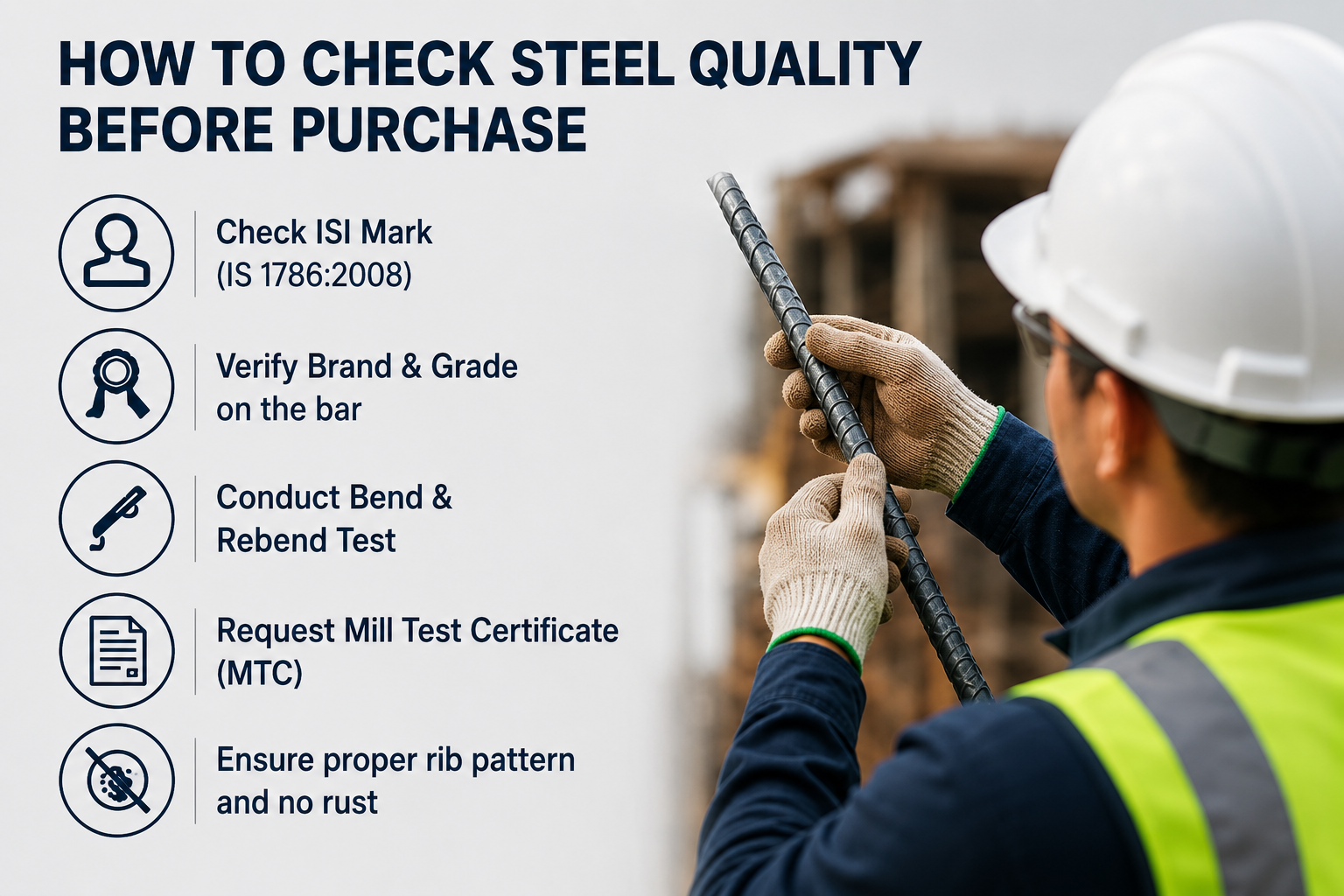
- Request Mill Test Certificates (MTC) Every batch of TMT steel should come with a mill test certificate from the manufacturer, documenting yield strength, UTS, elongation, and chemical composition. Verify that the certificate matches the delivery batch.
- Check the BIS Licence Mark Look for the ISI mark and BIS licence number rolled into the bar or stamped on the bundle tag. This confirms the manufacturer holds a valid BIS licence under IS 1786:2008.
- Verify the Grade Marking IS 1786:2008 requires manufacturers to roll the grade designation into the bar surface. Fe-500D bars, for example, carry a specific rib pattern or marking that distinguishes them from Fe-500.
- Conduct a Simple Bend Test While not a substitute for lab testing, a site-level bend test (bending a bar 180° around a mandrel of specified diameter without cracking) provides a basic ductility check. Bars that crack or show surface fractures at this stage should be rejected.
- Third-Party Lab Testing For large residential projects or where procurement source is uncertain, send representative bar samples to a NABL-accredited testing laboratory for full mechanical and chemical property verification.
Across projects managed through the Noah Quality Assurance Framework, steel testing protocols are built into the material approval process before the first bar reaches the site.
7. Common Mistakes During Steel Procurement
Buying on price alone: Unit cost comparisons without grade and source verification lead to inconsistent quality on site.
Accepting mixed grades: When Fe-415 and Fe-500 bars are mixed on site without clear identification, structural members may be under-reinforced relative to the design intent.
Ignoring storage conditions: TMT bars stored in contact with soil or exposed to moisture for extended periods can develop surface corrosion. While light rust does not significantly affect bond strength, heavy pitting reduces effective cross-section.
Skipping mill test certificates: Verbal assurances from suppliers carry no structural or legal weight. Every delivery should be accompanied by documentation.
Over-specifying grade without engineering justification: Specifying Fe-550 for a two-storey house that structurally requires Fe-500 increases procurement cost without improving safety. Grade selection must follow the structural design, not a general assumption that higher is better.
8. How Noah Infrastructures Approaches Steel Selection
At Noah Infrastructures, material specification follows the Noah Design-to-Delivery Framework, a structured process where structural design, material selection, and procurement are aligned before site work begins.
Our approach to steel for house construction:
Steel grade is specified in the structural drawings. Fe-500D is our default recommendation for projects in seismic zones III and above, given its superior ductility under earthquake loading. For projects in zone II, Fe-500 from BIS-licensed manufacturers is the standard specification.
Procurement is vendor-qualified, not spot-purchased. We maintain an approved vendor list of BIS-licensed TMT manufacturers, validated through mill test certificates and independent testing.
Mill test certificates are reviewed and filed before any batch is approved for use on site. Our site engineers cross-check batch markings against certificates during delivery.
Storage and handling protocols are part of our site quality plan. Steel is stored above ground level on supports, covered when not in immediate use, and audited at defined intervals.
This process eliminates the procurement ambiguity that causes quality problems later in construction.
9. Key Takeaways
- Steel for house construction in India means TMT bars conforming to IS 1786:2008.
- Fe-500 is the standard grade for residential construction. Fe-500D is preferred for seismic zones III, IV, and V.
- Never select steel grade based on cost alone. Grade selection must follow your structural drawings.
- Demand mill test certificates from every supplier before accepting a delivery.
- Check for BIS licence marks and grade markings on every bar.
- Third-party lab testing adds an important verification layer on larger projects.
- Storage and handling conditions affect steel quality between delivery and placement.


